Feature
Simple majority, supermajority, unanimity – each with a quorum
Nobody should have to work out at the kitchen table whether a motion passed. Beschlussmanager applies the rule from your statutes, counts, and reports the outcome so that it can be checked.
yes > no
Simple majority
The motion passes if more yes than no votes were cast. The usual rule for day-to-day business.
yes ≥ threshold
Supermajority
Any threshold above 50 per cent – typically two thirds or three quarters. For amendments to statutes and weighty decisions.
no dissent
Unanimity
Everyone who votes must agree. For cases where a single no vote defeats the motion.
In addition
Quorum
Each of the three rules can be combined with a minimum turnout: the share of eligible voters who must have voted for the outcome to count.
Example: seven eligible voters, 50 per cent quorum, simple majority. At least four people must vote. If only three do – even if all three vote yes – the resolution has not been passed.
During the vote Beschlussmanager shows how far turnout has come, and the outcome states separately whether the quorum was met and whether the majority was reached.
Counting
What Beschlussmanager shows while a vote runs
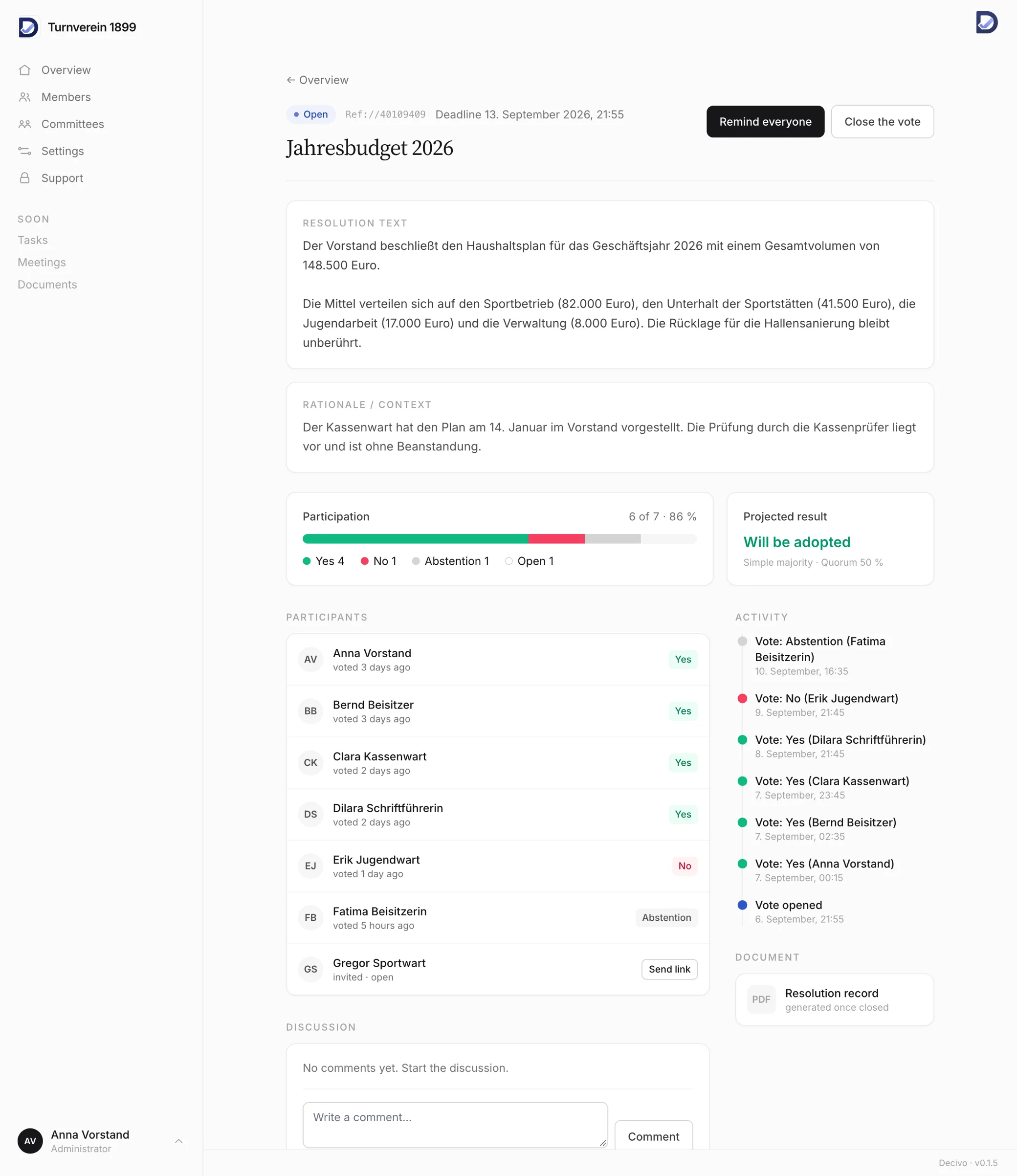
Yes, no and abstain are counted and reported separately, alongside turnout against the number of eligible voters.
While the resolution is open, Beschlussmanager shows a projected outcome – labelled as such. It can change with every further vote and is not a result while the deadline is running.
At the deadline the resolution closes by itself. Only then is the outcome fixed, reported to everyone involved and written into the PDF. Nobody has to remember to end it.
From the application
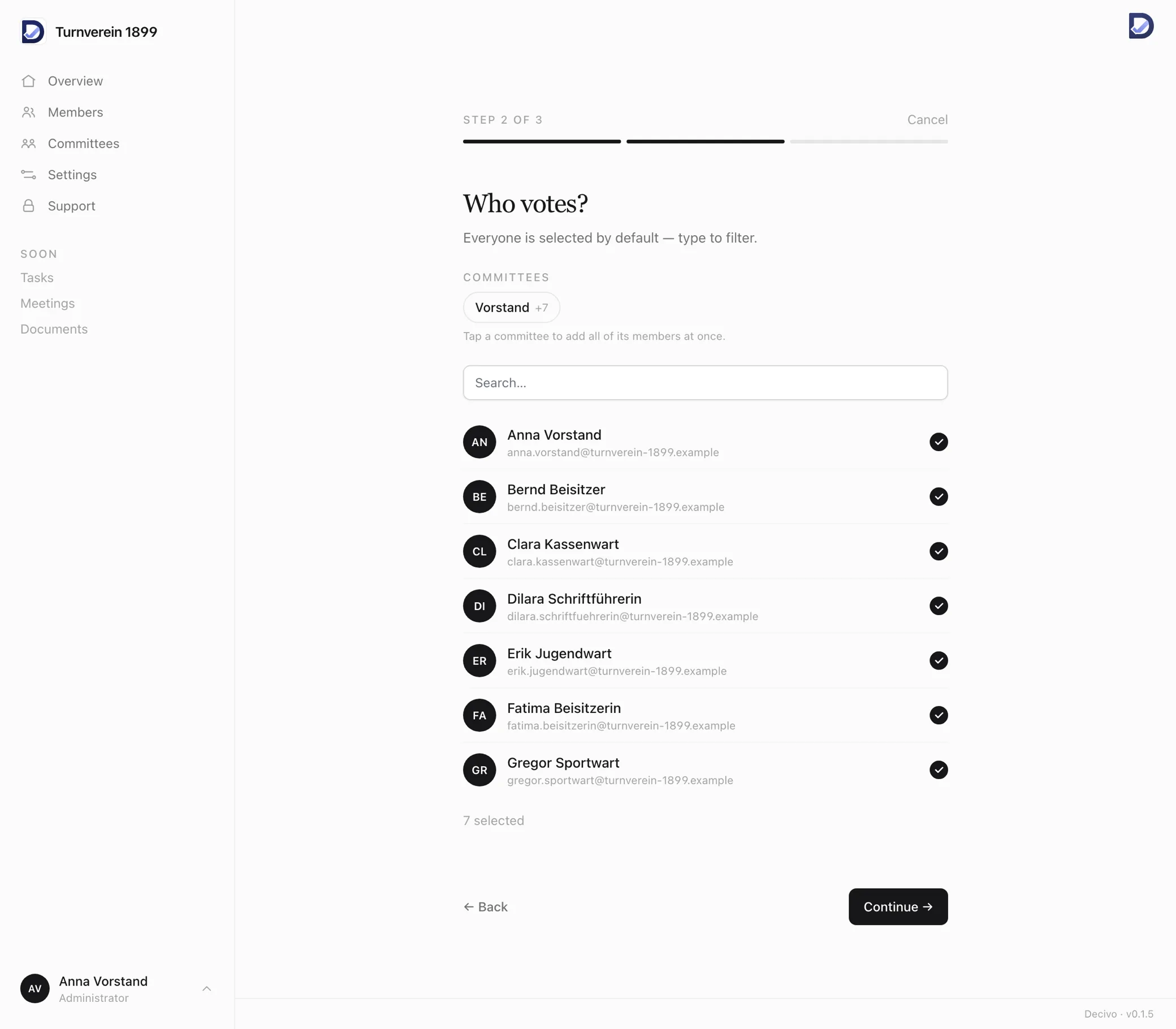
Who counts is settled beforehand
A quorum is a share, and a share needs a denominator. It is fixed when the resolution is created, not afterwards.
From the application
Counting while the vote runs
Turnout, votes, the likely outcome and who is still missing — on one page, with nobody doing the arithmetic.
Common questions
Does an abstention count as a no?
That depends on the rule your statutes set. An abstention is not a no vote, but it can affect the majority depending on whether it counts towards the votes cast. Beschlussmanager reports yes, no and abstain separately so both readings stay traceable.
What is the difference between majority and quorum?
The majority concerns the ratio of the votes cast: how many yes votes does the motion need? The quorum concerns turnout: how many of those eligible must have taken part before counting is allowed? They apply independently.
Can we set 50 per cent as a supermajority?
No, and that is deliberate. A supermajority is by definition above a simple majority, so Beschlussmanager only allows thresholds above 50 per cent – two thirds and three quarters being the usual ones. If you want a simple majority, pick that rule.
What happens if the quorum is missed?
Then the resolution has not been passed, regardless of the ratio of votes. Beschlussmanager states that explicitly in the outcome and in the PDF rather than reporting a majority with no basis.
Ready for the first resolution?
We set up your organisation and get back to you within one working day. No payment details, no contract as a first step.